T568B insidewiremap · split · shield

Best RJ45 Testers (2026) - and the Wire Order They Check

An RJ45 tester is the tool that ends the oldest argument in home networking: is it the cable? This page lists the models worth owning and the exact wire order they check - because a tester is only as useful as your ability to read what it says.

#1

Eclipse Enterprise 902074 RJ45/RJ11 Tester ~$8-10

Verdict: The cheapest way to prove a cable is dead - and nothing more.

  • Wiremap only: 8 LEDs light in order
  • RJ45 + RJ11 ports
  • Slow and off/speed switch
  • No length, no POE, no shield test

Fits: A drawer backup for the occasional patch cable check.

Check 902074 price on AmazonAmazon search link - we earn nothing from it (no affiliate account on this category yet); specs above are from public product pages.
#2

Klein Tools VDV526-100 LAN Scout Jr. ~$15-20

Verdict: The default home-network tester: fast pass/fail with fault location.

  • Wiremap with fault IDs: open, short, crossed, split
  • RJ45 + RJ11
  • Auto or manual scan
  • No length measurement, no POE

Fits: Homeowners and small-office patch panels - the gift that ends "is it the cable?" arguments.

Check VDV526-100 price on AmazonAmazon search link - we earn nothing from it (no affiliate account on this category yet); specs above are from public product pages.

#3

Klein Tools VDV526-052 LAN Explorer Jr. + Coax ~$25-30

Verdict: LAN Scout Jr. plus coax ports - the right pick when TV cable shares the drawer.

  • Everything the VDV526-100 does
  • Adds F-connector coax mapping
  • Shield test for STP runs
  • Still no length or POE

Fits: Homes mixing ethernet with coax (cable TV / MoCA adapters).

Check VDV526-052 price on AmazonAmazon search link - we earn nothing from it (no affiliate account on this category yet); specs above are from public product pages.

#4

NOYAFA NF-8209 ~$45-55

Verdict: The feature cliff: length measurement, POE detection and NCV in one handheld.

  • Wiremap + fault location (open/short/cross/split)
  • Length measurement up to ~300 m (calibrated)
  • POE detection: which pairs carry power, standard or passive
  • NCV livesafe + port flash
  • Screen readout instead of LED-only

Fits: Anyone running or repairing cable professionally part-time - the best value in the list.

Check NF-8209 price on AmazonAmazon search link - we earn nothing from it (no affiliate account on this category yet); specs above are from public product pages.

The wire order every tester compares against

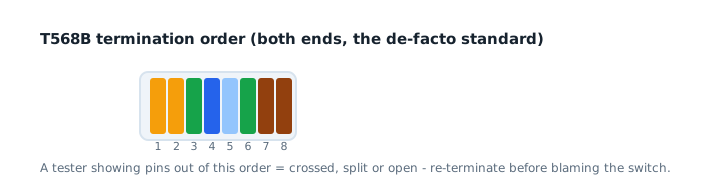
T568B termination order diagram with the eight conductor colors
Print this, tape it inside the crimping tool drawer.

T568B is the de-facto standard for new installs (T568A survives in government and existing phone-line retrofits). What matters practically: both ends must match. A-B ends produce a crossover cable - harmless on modern gear with auto-MDIX but a genuine trap on older hardware. And the four "white-stripe" conductors are where terminations go wrong: if pin 3 and pin 5 conductors swap, the cable passes a cheap tester and fails a gigabit negotiation - that is a split pair, and only testers with the detection circuitry will tell you.

Reading the tester like a pro

  1. Test both ends plugged in, remote first. Most testers split into main + remote; plug the remote into the far end so the full run is in circuit.
  2. Watch the sequence, not just the lights. 1-2-3-4-5-6-7-8 in order is a pass. Numbers skipping = open; two numbers together = short; out of order = crossed or split.
  3. Re-test after any re-termination. The second-most-common fault is the one you just introduced fixing the first.

The tier logic behind these picks (and what length and POE testing add) is broken down in the buying guide; if the tester says the cable is fine but the network still fails, the fault is upstream - the ethernet troubleshooting ladder picks up from there.

Frequently asked questions

What pins does an RJ45 tester check?

All eight conductors, against the T568B order: white-orange, orange, white-green, blue, white-blue, green, white-brown, brown. Both ends must match; a tester reports opens (broken conductor), shorts (two touching), crossed (two swapped) and split pairs (a pair split across two pairs - the sneaky one).

RJ45 vs RJ11 on a tester - what is the second port for?

RJ11 is the telephone connector; combo testers include it because the same tool covers phone lines and DSL modems. The RJ45 port is the one for ethernet - wider, eight pins.

Can a tester tell Cat5e from Cat6?

Not by looking - the category lives in the cable jacket print and the manufacturing tolerance, not in the wiring. A professional tester certifies a run to a category standard; cheap testers only verify wiring order.

My tester shows pin 5 open - now what?

An open means one conductor is cut or not making contact. On a patch cable, replace it. On a run, check the two terminations first - re-punch or re-crimp both ends before chasing the middle of the cable; most opens live within two centimeters of a plug.

Do I need a grounded tester for STP cable?

You need a tester that checks the shield connection, not necessarily a grounded one. If the spec does not mention shield testing, assume it does not do it.