Network Cable Tester: Home, Pro or POE - Which Do You Actually Need?
"Network cable tester" is the umbrella the market sells under; the buying decision hides in one question - what lives on the other end of your cables? A desktop PC needs a different tester than a camera pole. This page sorts the market by scenario instead of by spec sheet.
Scenario 1 - the home network (pick the $15-20 tier)
Home ethernet problems are overwhelmingly physical: a patch cable crushed by furniture, a keystone jack
punched in the wrong order, a pet-chewed run behind the TV. A wiremap tester - the
Klein LAN Scout Jr. tier - settles every one of these in ten seconds. The
capabilities that cost real money (length, POE, link reports) answer questions home networks rarely
ask: your runs are short, your switch POE budget is your own business, and when something breaks you
replace the $5 patch cable rather than document the repair.
The one home scenario that justifies an upgrade is self-termination: if you crimp your own ends or punch keystones, split pairs become your personal risk. A tester without split-pair detection will show eight happy green LEDs on a cable that negotiates 100 Mbps forever - the NOYAFA NF-8209 catches it and tells you the run length while it is at it.
Scenario 2 - part-time installs and repair work (the $45-60 tier)
Once someone pays you to touch cable, "probably fine" stops being an answer. The prosumer tier adds the three capabilities that turn arguments into printouts: length measurement (prove the run is inside the 100 m limit, or find how far down the conduit the break sits), POE detection (is the port powering, on which pairs, at which standard), and a screen that shows the fault instead of making you decode LEDs. The NF-8209 owns this tier because it bundles all three at a price that hurts less than one callback.
Scenario 3 - professional cabling and IT (the Fluke tier)
Professional work is documented work. The LinkSprinter class tester does everything above plus a true link test - it negotiates with the switch, reports the port identity (CDP/LLDP), the negotiated speed, gateway and DHCP reachability - then hands you a report you can hand to a client. That is also why it costs four to ten times the home tier: you are buying certified answers, not LEDs.
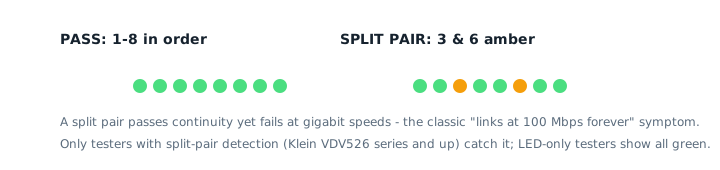
POE deserves its own paragraph
Power over ethernet turns any cable run into a power cord - and turns misdiagnosis into a specialty. A camera that will not boot might be a dead camera, a wrong POE budget, or a cable with a split pair that carries data but not power at length. A tester with POE detection answers in seconds: standard or passive power, which pairs, live or dead. If your network carries cameras, APs or VoIP phones, POE detection is not a nice-to-have - it is the reason to skip the cheapest tier entirely.
Frequently asked questions
Is a network cable tester different from an ethernet tester?
In practice the words overlap: a network cable tester covers the copper media a LAN uses - Cat5e/Cat6/Cat6A ethernet plus often RJ11 phone and coax. An "ethernet cable tester" is usually the same device named after its main use. Buy by capabilities, not by which word is in the listing.
What should a home user test beyond wiremap?
Two things earn their keep: split-pair detection (the most common field-termination fault and invisible to LED testers) and length, which tells you whether a long run exceeded the 100-meter ethernet limit before you blame the switch.
What does a professional install need that a home kit lacks?
Documentation. Pro work ends with proof: a link report showing the switch port, negotiated speed and POE status per run - which is the LinkSprinter tier. Some contracts literally require the printed report.
Do testers work on shielded (STP) cable?
The good ones test the shield too - an ungrounded or broken shield defeats the interference protection you paid for. Check for a shield test in the spec before buying if your plant is STP.
Can one tester cover phone (RJ11) and coax too?
Many do: the Klein VDV series handles RJ45, RJ11 and F-connector coax in one body. If your walls carry all three, a VDV-style combo tester replaces three single-purpose tools.